I’m incredibly fortunate to be a piano teacher and music composition instructor to students of all ages a few days each week. I also perform, compose, create content for YouTube, and write music education books. My time is spent nurturing the imagination. As Samuel Taylor Coleridge beautifully put it, “The primary Imagination I hold to be … a repetition in the finite mind of the eternal act of creation in the infinite I AM.”
It’s quite common for younger students to study with me, in some cases because of the decline of music in schools and the lack of imagination in the curriculum. I teach students from both my home studio and online sessions, and almost all of them are studying the same set of works! Imagine that, all the students across the UK listening to a microcosm of the musical repertoire available.
Since the late 1990s, music and drama education in UK schools has faced a sharp and sustained decline. This decline was particularly pronounced after the introduction of the English Baccalaureate (EBacc) in 2010. GCSE entries for arts subjects have fallen by nearly 50%, with music and drama GCSEs alone dropping by over a third. A-level entries show similar trends, and over 40% of schools now enter no pupils at all for these subjects. The number of specialist teachers has also dropped significantly, with music teachers declining by more than half since 2012. These cuts disproportionately affect students from disadvantaged areas, deepening inequality and limiting access to creative pathways. As William Blake wrote, “what is now proved was first imagined.” If we are merely passing on the same code we were taught, is there any hope for humanity to rise above this materialistic monoculture? Matter, being just an epiphenomenon of consciousness, raises questions about the true nature of reality and our place within the cosmos. Not that I see reality as something outside of us; all there is to the movie is the screen; the movie can’t exist outside the screen. Without a re-enchantment, do we have much hope of arriving at Barfield’s Final Participation?
Original Participation, as Owen Barfield describes it, is an early form of human consciousness in which people experienced themselves as deeply connected to the world, not as detached observers, but as participants in a living, spiritual reality. It’s like a garment we wore. In this state, there was no distinction between inner and outer, mind and matter; the world was imbued with inherent meaning. However, as we educate ourselves in an increasingly egoistic curriculum that emphasises separate selves, I can’t help but ponder the challenges and uncertainties that lie ahead. Final Participation is not a return to the old unity, but a conscious, awakened reunion with meaning. It’s the moment when the heart and mind know they are shaping the world as they perceive it, taking responsibility for that gift.
This erosion of arts education mirrors the symbolic loss at the heart of Owen Barfield’s The Silver Trumpet. A kingdom that grows spiritually barren when its music disappears. In both fiction and fact, the absence of music and drama in young lives represents not just a curriculum shift but a cultural and emotional impoverishment. For me, music is not just entertainment but a spiritual practice. The kind of music I’m known for is improvisation. I play a concert without a plan, sitting at the piano and simply starting. Every note I play informs the next. These concerts leave me and the audience forever changed, as they can never be reproduced — a simpatico. These concerts are recorded, and I’m always shocked to hear myself playing this music. It feels like I’m the conduit for the music; it’s not me playing it somehow. The improvisations are a communion with something larger than myself.
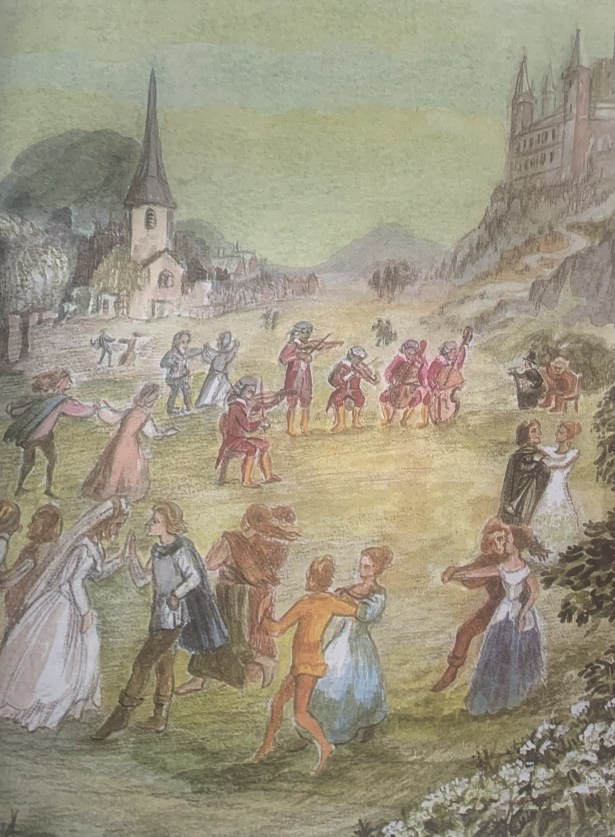
“On and on and on they danced…” An illustration of the ending of The Silver Trumpet by Josephine Spence in the 1986 edition.
There was once a time, in a kingdom not so unlike our own, when music could still speak to the soul. In The Silver Trumpet, music is not entertainment, it’s the very essence, a spiritual tone that resonates with our deepest soul. The Aeolian window harp was not just an instrument. The delicate strings waited until the air moved and the harp started to sing, remembering the forgotten songs. Shaped by the movement of the air, no fingers and no pressing. Reminding us that not all music is made but revealed. The two sisters are initially called Violetta and Gambetta before being called Violet and Gamboy. This is a musical reference to the historically bowed instrument from the Baroque and Renaissance periods called the viola da gamba. Unlike the modern violin family, the viola da gamba is held between the legs, closer to the body, and its sound is warmer, more intimate, almost like a human voice speaking in tones of sorrow and tenderness. Its role was not to dazzle with virtuosity, but to converse, to accompany, to draw the listener inward. Barfield’s naming here is not accidental; it hints at an older relationship with music, one less about display and more about communion, a reminder that music at its heart is not external performance, but a dialogue between the human soul and the unseen.
For Rudolf Steiner, music was the formative force. The vibrations of sound, not just passing through the air but shaping our moral perceptions and restoring our inner harmony. The loss of the trumpet marks more than an absence of music; it’s a loss of the soul’s connection, a fallen ego. The trumpet, for me, symbolises something far greater than music, reminding us who we are, a bridge between the human and the divine, between the seen and the unseen. The silver trumpet is not elsewhere; it is the resonance of being, always here, waiting to be heard.
The book concludes with the discovery of the trumpet, symbolising the recovery of what had been lost. To truly reveal what is always present and available to us, we must undergo a profound shift in consciousness. Not only in our mainstream music education system but in the soul of our culture. We need to reimagine education as something more than the transmission of data or the reinforcement of fragmented thinking. It must become a space for wonder. Barfield envisioned a participatory relationship with the world. Music, imagination, and the arts are not luxuries but essential conduits for this transformation, reminding us that meaning is not imposed from the outside but discovered within. A curriculum rooted in mechanistic outcomes cannot nourish the soul. What is needed now is a re-enchantment, a turn toward unity, creativity, and a deep recognition that reality is not separate from us but arises through us. Only then might we begin to hear the silver trumpet again, not as a forgotten symbol, but as the true voice of the human spirit. In the closing of Paradiso, Dante reaches the final vision of God. His sight becomes perfectly clear, and he perceives the unity with the divine essence. He sees the mystery of the Trinity and the incarnation of Christ, humanity and divinity joined in one. Overwhelmed by the perfection of this vision, his intellect and will align completely with God’s infinite love, and he experiences absolute peace as his soul is drawn into the eternal harmony of divine motion.