Category: Responses

Peace-Making and the Economic Earth: on Barfield’s 1936 letter on “Nationalism and Economics”

Ninety years ago, on April 3, 1936, The Spectator published a letter to the editor by Owen Barfield, which it headlined “Nationalism and Economics”. The letter, about the reality of the world’s economic life and the failure of that reality to be reflected in relations between nation-states, repays attention in 2026. The states uppermost in our minds have changed, and to some extent so have the raw materials being sought and the products being sold. But the failure remains the same.


Continue Reading

The Music That Shapes the Soul: Owen Barfield, Original Participation, and the Future of Education

I’m incredibly fortunate to be a piano teacher and music composition instructor to students of all ages a few days each week. I also perform, compose, create content for YouTube, and write music education books. My time is spent nurturing the imagination. As Samuel Taylor Coleridge beautifully put it, “The primary Imagination I hold to be … a repetition in the finite mind of the eternal act of creation in the infinite I AM.”

It’s quite common for younger students to study with me, in some cases because of the decline of music in schools and the lack of imagination in the curriculum.


Continue Reading

Haunted by Heidegger

We are haunted by Martin Heidegger. Even if you’ve never read a word of his dense philosophical texts, his ghost walks beside you, shaping how you imagine your place in the world. His spectral influence permeates our modern consciousness, guiding how we understand our relationship to reality, technology, and meaning itself. Heidegger’s philosophical project emerged as a desperate attempt to resolve the existential crisis that had been brewing in Western thought explicitly since the Romantic era—a crisis most eloquently articulated by Samuel Taylor Coleridge, who recognised the growing chasm between subjective experience and the objective world.


Continue Reading

Owen Barfield’s Reception of The Abolition of Man by C. S. Lewis

Owen Barfield, whom C. S. Lewis described archetypally as his “Second Friend” – “the man who disagrees with you about everything […] not so much the alter ego as the antiself” – on a number of occasions expressed his agreement with the argument of The Abolition of Man, and his admiration of the book. For example, describing various means by which one can become aware of the presuppositions of one’s thoughts, Barfield once wrote:

One, of which the best example I know is C.


Continue Reading

Reflections on a Passage from “Meaning, Revelation and Tradition in Language and Religion”

The following contains some thoughts inspired by a very striking passage in Barfield’s late essay “Meaning, Revelation and Tradition in Language and Religion.” In reflecting on the Incarnation, he considers what it would mean for a divine-human person to speak. He suggests that—while an ordinary human child, in beginning to speak, is bound by the limitations of human memory (and, it is implied, by a language into which they are born, with its sedimented history of meaning)—Christ was either not limited in this way, or the limitation was “voluntarily accepted.”


Continue Reading

“Barfield’s understanding of language was one I had never encountered before”: an interview with Spencer Klavan

Landon Loftin: Hello Spencer. Congratulations on your newest book: Light of the Mind, Light of the World. Can you say something about the book’s main thesis?

Spencer Klavan: Thanks very much indeed, Landon. Light of the Mind, Light of the World is a new history of science from a religious perspective. My hope is to change not so much what specialists know about science, but how the average person thinks about science. I think we’ve gotten this badly wrong: most people walk around with an operating theory that the world works like a Lego set.


Continue Reading

Owen Barfield: Harbinger of the 21st Century

The following article was first printed in the 2005 edition of The Golden Blade, an annual anthroposophical publication which survived until 2009. It was written as the draft of a lecture ultimately given in the English Auditorium at the Goetheanum on Thursday 7th August 2003. As Simon Blaxland de-Lange wrote in a footnote to its appearance in The Golden Blade, “the actual lecture took into account what had been expressed during the preceding days of the second ‘English Week’ conference, and was strongly based on Barfield’s remarkable text of the modern mysteries, Unancestral Voice, from which several quotations were taken.


Continue Reading

On Attending the “Plotinus and Barfield” Conference at the University of Cambridge

In September 2023 I attended the first conference on Owen Barfield held at Cambridge University. That weekend, Cambridge basked in the golden embrace of a radiant sun, the city awash in warmth and light. This year’s conference, titled Plotinus and Barfield: Emanation and Evolution, took place on 14th September, and the atmosphere in Cambridge was no different. As I wandered through the narrow streets toward the Divinity Faculty, I crossed over quaint bridges, where punting boats lay moored, poised for a busy day of guiding tourists along the river, offering them glimpses of the city’s breathtaking architecture.


Continue Reading

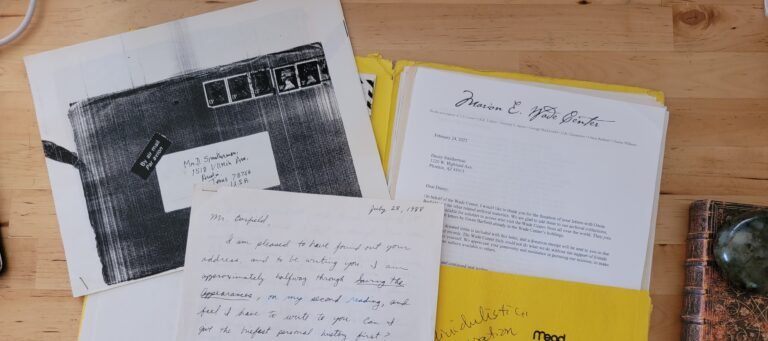
Accidental Philosopher: How Owen Barfield Derailed My Life

Sharing my correspondence with Owen Barfield is a gift that I’m honored to bestow. Beginning in 1988 – when he was 90 years old – we traded letters until 1995, two years before he passed. He sent copies of essays and talks of his, and commented on poems and essays I sent to him. He recommended books to read. I told him of authors I’d found. All told, I have sixteen letters from him.

Sharing my correspondence is also humbling. It does involve two people, after all, and only makes full sense when both people are taken into account.


Continue Reading
Silje Lilly - Sunset at l'étang de l'or

A Sonnet for Barfield

‘…the poetic… that bodiless ocean of life out of which all works of art spring.’
Owen Barfield


We participate in one and the same
Consciousness, feeling its sudden changes.
Hark! Our keel scraping against pebbles,
The impending bed pronounces your name
In metallic whispers.


Continue Reading