This article by Simon Blaxland-de Lange was first published in New Economy, a journal of associative economics, in its March/April 1997 edition. It is apparent from the text that it was written in 1996. As Blaxland-de Lange notes, in an endnote in his biography of Barfield, to some extent the article is the fruit of conversations with Barfield which they had, while he was also engaging with him as a biographer towards the end of Barfield’s life. The article is reproduced by the kind permission of Simon Blaxland-de Lange. The article might profitably be read alongside Rory O’Connor’s recent essay, posted on this blog in April 2026, titled “Peace-Making and the Economic Earth: on Barfield’s 1936 letter on ‘Nationalism and Economics'”.
In a pamphlet published in 1937,[1] an early proponent of associative economics, Owen Barfield, pondered on the nature and purpose of trade unions in Britain. He distinguished between their political role as champions of workers’ rights, and, for Barfield, the more dynamic role they could have had of fostering economic associations — that is, the working together of producers, distributors and consumers, which is the cardinal feature of associative economic life. “Suppose the trade unions were to become fully aware of their existing, and still more their possible functions as true economic associations. Suppose they were to make a new and deliberate choice, emphasising henceforth the associative principle, pursuing less ardently the other political principle of their being. I believe the effect would be an immediate relief of political tension…”
“Suppose”, Barfield continues, “there arose into being an ‘economic England’, not any corporate body defined by a frontier, and still less one pursuing any competitive and diplomatic policy, but a collection of associations, not one, but many and overlapping, associations with which the economic associations existing within other nations were able to have mutual economic intercourse… I believe the effect would be incalculable. It would be a step towards genuine internationalism, without being at the same time a challenge to national sovereignty…”
It would be interesting to reflect on what might have happened had this avenue been followed up. Instead, arguably because of Britain’s failure to take even the merest step towards this goal in the economic sphere, the political and cultural fabric of Europe became torn asunder during World War II, giving rise to social democracy in Western Europe generally and to Britain’s post-war consensus.
Although relatively long-lasting, this British version of the compromise between individualism and socialism lacked real viability and gave rise to a movement that set out to ensure the demise of the consensus. Gathering momentum during the 1970s through the medium of various right wing ‘think tanks’, the move to end the consensus came in the form of Mrs Thatcher’s government. The many years of Thatcherite policies since have left British society infected with the social equivalent of a creeping virus of immense destructive potential. And now New Labour has taken upon itself the challenge to try and overcome the disintegrative effects of Thatcherism, a task for which — and here I cannot remotely share Will Hutton’s optimism that a social-democratic solution can again be found[2] — a degree of political control hitherto unknown in this country, and made possible by information technology, will be found necessary. While the Conservative Right defends its culture of earth-bound atomising individualism, New Labour will employ every ounce of ingenuity it can muster to divert people’s (and especially children’s) attention to the virtual-reality world of cyberspace in the endeavour to foster a spirit of conformism.[3] All this, resulting from the absence of an associative economic life, leaves us in 1996 in a situation which is in many ways similar to that which concerned Barfield in 1937. The difference is that now the calamity that is likely to befall us if we fail to implement the idea of economic associations will be of even greater magnitude than it was before the war.
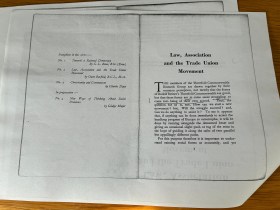
Law, Association and the Trade Union Movement, the pamphlet from which Simon Blaxland-de Lange quotes at the essay’s beginning. The underlinings are Barfield’s own.
Moreover, the twentieth century has also seen Central Europe have its heart torn out and become subject to the unbridled ascendency of western materialistic individualism (balanced only by the reactionary bureaucratism emanating from Brussels). In this context, Britain has a quite particular responsibility in our time to bring a transforming impulse to the economic realm of the social order, which is currently so dominant and with which it has so strong an affinity. But what does this mean in outward practical terms? Where, in particular, can we find an avenue through which such a transforming impulse can enter the economic sphere?
If we are to see clearly what needs to be done, we shall need to disentangle the economic sphere as such from all the infinite ramifications of politics. For one of the great riddles of British public life is that this country, which is in so many ways the epitome of individualism, is also — and of course this is precisely because of the fears engendered by that very individualism — bedevilled by group-consciousness of one kind or another. People still want the security of political hierarchy, they want something to believe in, aspire towards, worship. Sadly, the only god available in modern times is money, betempled in the world’s financial markets. And through the worship of money it continues to be possible for the abstract notion of social class (now understood almost wholly in monetary terms) to place an unbridgeable, because fictitious, divide between individual human beings.
If we want to get anywhere, therefore, we must first think away the whole political-financial rigmarole of Parliament and the City which would claim total sovereignty over our lives. We will then be left first and foremost with the real components of economic life — human beings and the natural world around us. Then, too, it will be evident that we have a choice to make — either to collaborate with one another out of a sense of brotherhood and common earthly citizenship, or to ignore one another in parallel quests for egotistical self-betterment.
In terms of one’s attitude to money, this would then mean that, instead of thinking primarily of how to acquire money, one would put one’s consciousness as far as possible into the way one spends one’s money. This, and only this, can engender the foundation for economic associations in our time; for these remain a vain hope unless the sleeping giant of the consumer is awakened, consciously directing his actions so that economic brotherhood can gradually spread from individuals working together over the entire earth, albeit from tiny local centres to begin with.
A practical example of this alternative is the community-supported farm (more generally known, especially in America, as community supported agriculture or CSA), in contrast to the supermarket, which symbolises on this level the life-style of modern time that is hurtling in the opposite direction. Agriculture is fundamental to the engendering of economic associations today, and if we can form such land-based economic associations in our local areas, with producers, distributors and consumers working in partnership, it may gradually become possible to restore health to the financial world also. This remains an integral part of establishing world economic brotherhood, the forming of which is the most essential task of modern times.[4]
In its substance, the challenge before us is very similar to that contemplated by Owen Barfield in the 1930s, the establishing of economic associations. But the need to meet this challenge has now become greatly deepened and intensified, and its context is no longer the world of work alone. It is still a task open to trade unions, but the same task confronts politicians, business-people and consumers generally. In short, the whole of human life of earth.
[1] Law, Association and the Trade Union Movement, Threefold Commonwealth Research Group, London 1937.
[2] See his much-acclaimed The State We’re In, Vintage Books, 1996.
[3] While I hope this sentence will be meaningful in its own right, I would recommend that readers who are intrigued by these images study John Davy’s remarkable essay, “Scientific Progress and the Threshold”, in Hope, Evolution and Change, Hawthorn Press, 1985.
[4] For some valuable insights as regards the future of money, see Christopher Houghton Budd, Of Wheat and Gold, New Economy Publications, 2nd edition, 1996.